Dental tourism: what it is, and how to decide.
Dental tourism means traveling to another country for dental care, usually to pay less than you would at home. People often add a short holiday to the trip. The work is the same kind of work a dentist does at home. The country matters less than the clinic you pick and how carefully you check it. This guide walks through what it is, who goes, where, what it really costs, and the risks.
What dental tourism means
Dental tourism is easy to define: it means traveling to another country to get dental work done, most often to pay less than the price at home. Many people add a few days of sightseeing, which is where the name comes from.
It is a big part of health travel. The United States CDC says dental care is the most common form of medical tourism among people who live in the United States. Smartraveller is the Australian Government's travel advice service. It lists dentistry among the procedures Australians most often go overseas for. A 2023 review in the British Dental Journal puts dental care at about one third of all medical tourism. It also says medical research has paid the subject little attention.
You will also see it called tourism dentistry, medical dental tourism, dental travel or a dental holiday. They all mean the same thing. The table shows the small differences.
| Term | What it points to |
|---|---|
| Dental tourism | Traveling abroad for dental care. The common name. |
| Tourism dentistry | The same idea, with the two words swapped around. |
| Medical dental tourism | Dental care seen as one part of medical tourism, which covers travel for any kind of health care. |
| Dental travel, dental holiday | The trip itself: the treatment plus the time spent in the country. |
The treatment is the same kind of treatment. A dentist abroad fits the same crowns and places the same implants as a dentist back home, using materials from the same global makers. A lower price is mostly about lower running costs, though standards still vary from clinic to clinic.
Sources: United States CDC Yellow Book on medical tourism; Smartraveller on medical tourism; Felkai and others, British Dental Journal, 2023. Read 11 October 2026.
Who goes for dental work, and why
Most people who look abroad are facing a large bill at home. Price is the main reason, by a wide margin. The British Dental Journal review says most medical travellers go to pay less. It says dental patients mostly travel when they need a lot of work at once, such as implants done in stages.
At home, much dental work is paid from your own pocket. In Australia, for example, government covers little adult dental care, so much of the bill falls to the patient. The Australian Dental Association has pressed that point, calling for dentistry to be funded properly. In the United States, the CDC points to the rising cost of dental care. It also points to the many people there with no dental insurance, or too little of it.
One patient we looked after put it in plain words. In a published Google review, Roger wrote about a lifetime of dental issues and an expensive future in NZ.
"After a lifetime of dental issues and an expensive future in NZ, it was time to have a change."
Roger, published Google review. This is one person's own words. It is not a survey of patients, and it is not a medical result.
Money is not the only reason, though. Some people face a long wait for care near home. Others want to pair treatment with a trip they were going to take anyway. The review also names people who want a dentist who shares their language, and people who cannot get the treatment they need close by at all. This kind of dental travel is neither new nor rare.
Sources: Australian Dental Association on dental tourism; CDC Yellow Book; Felkai and others, British Dental Journal, 2023. Read 11 October 2026.
Dental tourism destinations: where people go
People travel to a handful of places for dental work. The dental tourism countries whose names come up again and again are Vietnam, Thailand, Bali in Indonesia, Turkey, Hungary, Mexico and Costa Rica.
Where you live shapes where you go. The British Dental Journal review says Western Europeans mostly travel to countries such as Hungary and Poland. North Americans tend to pick Mexico or Costa Rica. Australians tend to pick countries in Asia, such as Thailand.
Most lists rank these places by price alone. A price tells you nothing about who checked the clinic in person, or who licenses the dentists.
We work the other way. Dental Link covers two cities only, Ho Chi Minh City and Hanoi. Every clinic we send patients to has passed 18 checks. One of them is a visit on a normal working day by an advisor who lives in that city. They see patients being treated, and they check the sterilisation records.
Licensing is one thing you can look up for any country. In Vietnam, each dentist needs a practising licence from the Ministry of Health, or from the health department of the province or city. A licence shows a dentist may work. It does not show how a clinic is run, so licence checks are only 2 of our 18.
So choose a clinic you can check before a country with the cheapest number. The right destination for one person is not the right one for the next, because so much turns on your own case.
We do not call any one place cheaper or safer as a flat fact. Published prices and licensing for six countries sit side by side on our guide to the best country for dental implants, so you can weigh them for yourself.
Sources: Felkai and others, British Dental Journal, 2023; the United States CDC Yellow Book on medical tourism; ASEAN summary of Vietnam's licensing rules. Read 11 October 2026. For the published prices and licensing of the places we cover, see our own country comparison.
What dental tourism costs once travel is counted
The sticker price abroad is not the real price. The honest figure is the full trip, from the first flight to the last.
Treatment in these countries is often published well below home fees. At home a single implant is quoted about A$3,000 to A$7,000 in Australia and about US$3,000 to US$6,000 in the United States. In Vietnam, at a clinic we have vetted, a single implant starts from US$950. A full upper or lower row of teeth on four implants, called All-on-4, starts from US$3,900 per arch. Those are the clinic's own prices, not a promise about your mouth.
Then you add the rest of the trip.
- Flights and hotel nights. The stay includes the days the lab needs to make your teeth.
- Time off work.
- A second trip, in most implant cases. The implant has to settle before the final teeth go on, often 3 to 9 months later.
- Insurance that names planned treatment.
- Money set aside for a flight back if something needs fixing. The NHS is the United Kingdom's health service. It says to count possible return trips, and a longer stay, when you do the maths.
Who you pay matters too. Through Dental Link you pay the clinic yourself, at the clinic, with no deposit. Dental Link charges you nothing. The clinic pays our commission, and we check each quote against the clinic's own list price. Other services work in other ways. So ask any agency who pays it, and whether it wants a deposit.
Two rules keep the sum honest. Get the written treatment plan before you book flights. Price the second trip before you take the first.
So the gain is real for some people and thin for others, once the whole trip is counted. We never promise a saving. To weigh your own numbers, drop your home quote into our cost calculator, or read the honest, both sides guide to dental work abroad. For implants in detail, see our guide to dental implants abroad.
Sources: CDC Yellow Book; Smartraveller (Australian government) on medical tourism; NHS treatment abroad checklist; Cleveland Clinic on dental implants, read 11 October 2026; Australian single implant range, Finder Australia, read 12 October 2026; United States range carried from our best country for dental implants comparison.
Is dental tourism safe? The real risks
Is it safe? No country is simply safe or unsafe for dental work. Safety sits with the clinic, the dentist and the paperwork, not the map. Most of the risk comes down to distance. Here is what public health bodies say.
- Standards differ from clinic to clinic. The CDC says standards of care, including infection control, vary a lot outside the United States. It says the most common problems among medical tourists come from infection.
- Results are mixed. In August 2024 the president of the Australian Dental Association said some patients received good care overseas. He saw others return with major issues.
- A problem can show up once you are home. The CDC says travellers may then need care at home, and that it can be expensive. Smartraveller says it could cost more to fix a procedure that goes wrong.
- Cover is thin. Smartraveller says basic travel insurance rarely covers medical tourism, so sort out cover first.
- A warranty can be hard to use. That is true if you cannot read it, or cannot easily travel back.
Here is what we do about these, and where our help stops. We look at sterilisation records on our clinic visit. We ask for the warranty in writing before you agree to anything. A Dental Link advisor is in the room at your first appointment, and translates the plan, the materials and the warranty terms. A clinic comes off our list for any lapse in sterilisation, or for a brand in the mouth that does not match the quote. No check removes every risk. We are not dentists, so a clinical worry is one for your treating dentist, never for a website.
For a full checklist of what you can and cannot check from home, read our guide: is dental work abroad safe. If the work fails after you land back home, our guide to a dental warranty overseas covers what happens next.
Sources: CDC Yellow Book; CDC on medical tourism; Smartraveller on medical tourism; Australian Dental Association; Dental Link clinic vetting. Read 11 October 2026.
Flying home after dental treatment abroad
Your treating dentist decides when you can fly home, so ask before you book the return flight. A flight is part of every dental tourism trip, and it has its own effect on a mouth that was just treated.
A 2023 review in the British Dental Journal looked at this. It says pressure changes on the flight home can cause tooth or sinus pain after dental treatment, and that a patient should not fly home straight after a procedure. How long to wait depends on what was done.
The authors are frank about the limits. They found little research, and most of it was on military aircrew, not airline passengers. They found no waiting time in the medical manuals of the main airlines. They call their own guidance a starting point for the dentist's decision.
The NHS gives similar advice in plain words. Stay in the country where you had treatment long enough to recover before you travel home.
In practice, get your treatment plan before you book flights, and book the flight home with spare days in it. We do not print a number of days here, because that call belongs to your dentist. Follow your clinic's instructions.
Sources: Felkai and others, British Dental Journal, 2023; NHS treatment abroad checklist. Read 11 October 2026.
How to check a dental tourism clinic before you fly
You can check a clinic from home, by email, before you pay anything. Ask for documents, not opinions. A clinic that treats patients from abroad should be able to send them.
Dental Link runs 18 checks before a clinic can be sent a patient, and we publish all 18. You can run eight of them yourself. Ask the clinic for these.
- Its operating licence, with the name and address it covers.
- The registration of the dentist who would treat you.
- Its steriliser records.
- The name of the lab that makes the teeth, and the lab's certification.
- How many cases like yours this dentist has done.
- The implant or material brand in writing, with proof of supply.
- A written price list and an itemised plan.
- The warranty: how many years, what it covers, and how to claim.
The other ten need a visit, records or follow-up over time. An advisor walks through the clinic while patients are being treated. We compare quotes with the clinic's own list price. We ask each patient we place how it went, and we re-check every clinic each year.
Be careful with any site that only says a clinic is "verified". The CDC warns that medical tourism websites might not give full details of a clinic's accreditation, or of its staff's qualifications. It also says accreditation does not guarantee a good outcome. So ask what was checked, and by whom. Our answer is the page of all 18 vetting checks. The questions to email a clinic are in our guide on how to check a dental clinic yourself.
Sources: CDC Yellow Book; Dental Link clinic vetting. Read 11 October 2026.
How a dental tourism trip runs, step by step
A dental tourism trip runs in the same order almost anywhere: a written plan and price first, then flights, then treatment, then follow-up from home. Here is how it runs with Dental Link in Vietnam, the trip we know first hand.
- A free call. It takes ten minutes. You tell an advisor what you need, what you were quoted at home and when you want to travel.
- Two clinics, within a day. Your advisor sends two clinics that fit your case, with a filmed walk through of each. Clinic names stay hidden until your quotes arrive, so you compare the plan and the price first.
- Two written quotes. They usually follow within hours of your X-rays. Each one names the brand, the lab and the warranty.
- You choose one, or neither. Our commission is the same whichever clinic you pick.
- You book your flight. No deposit is asked for. The clinic books your appointments around your dates.
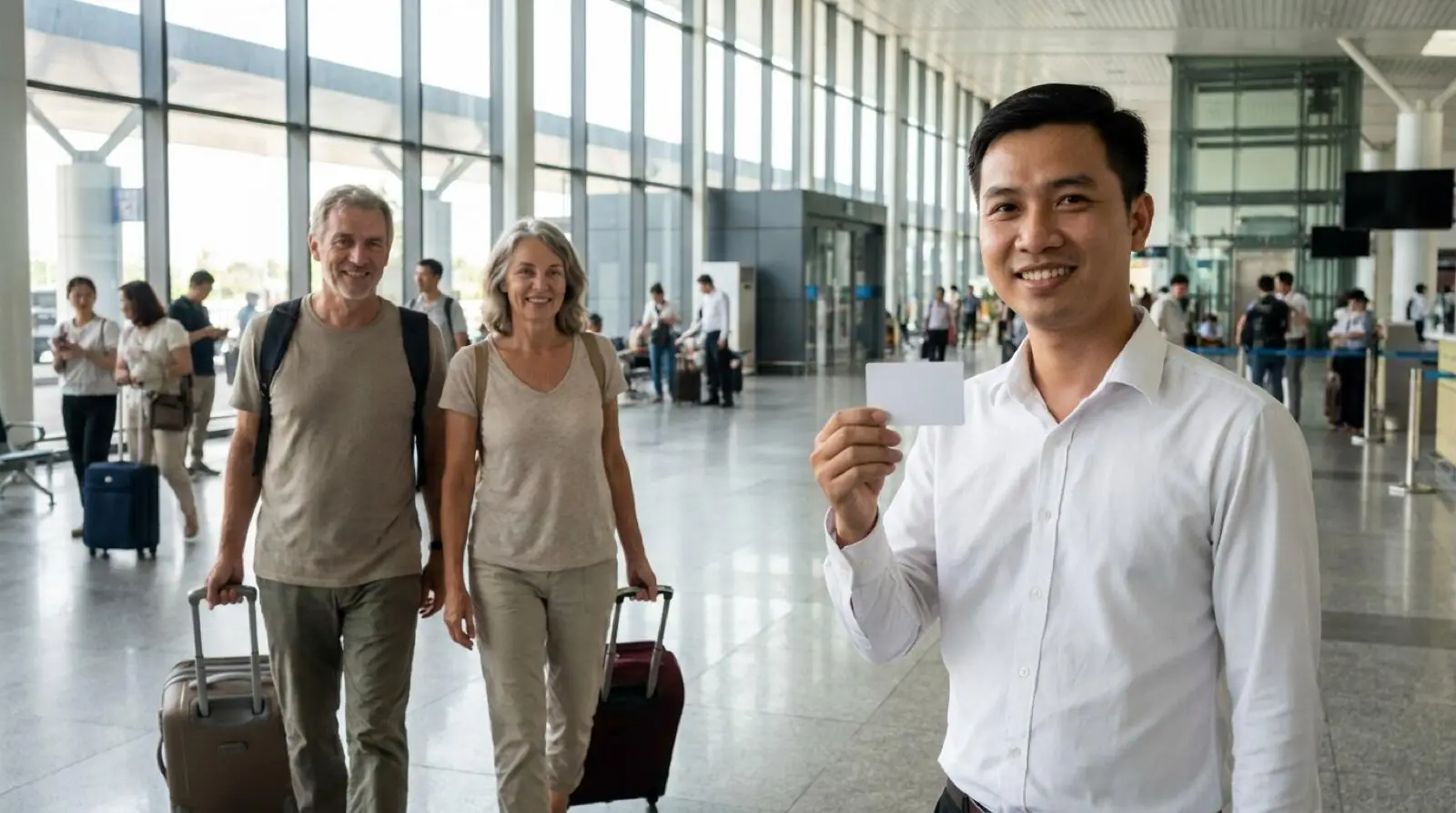
- You land. Our driver meets you at arrivals. Your advisor sits beside you at your first appointment and translates.
- You pay the clinic. You pay it yourself, at the clinic. You pay Dental Link nothing.
- You fly home. Your advisor checks in afterwards. Most implant patients come back for a second trip.
One patient wrote about step 5 in a published review. Regan Suter wrote about not paying anything until the treatment was done, at the dentist.
"...after speaking with Jordan from dental link I instantly felt relieved to know that I didn't have to pay anything until I was at the dentist after receiving the treatment..."
Regan Suter, published Facebook recommendation. This is one person's own words about Dental Link. It is not a medical result.
Booking on your own, or through another service? The order should be the same, and so should the paperwork. Be wary of a price agreed in the dental chair, or a deposit asked for before you have a written plan. Our own steps are set out in full on how a Vietnam dental holiday works.
How to decide if dental tourism is right for you
There is no yes or no that fits everyone. It suits some people well and others poorly. Five plain questions help you tell which group you are in.
- Is the gap between your home quote and the overseas quote large, even after flights and hotels?
- Is your case straightforward, and can it wait for a trip rather than needing care today?
- Could you make a second trip if the treatment needs one, or a repair later?
- Are you able to check the clinic, and read the warranty, before any money changes hands?
- Do you have cover for the treatment and for anything that goes wrong?
Start with your own dentist. They know your mouth and can set out your options first. Smartraveller says to talk to your doctor at home about your plans, and to get a health check at least 6 weeks before you go. We are not dentists, and we do not give treatment advice.
Then watch how you are being sold to. The NHS lists warning signs for any treatment abroad: a hard sell, a lack of information, pressure to decide quickly, no talk of possible complications, and no mention of aftercare. It says to think carefully before you book if you see one.
Reviews need the same care. Trust dental tourism reviews you can trace to a named person with a public profile, and be slow to trust an anonymous post. We publish our own reviews under patients' real names.
Sources: Smartraveller and CDC Yellow Book checklists for treatment abroad; NHS treatment abroad checklist. Read 11 October 2026.
Common Questions About Dental Tourism
What is dental tourism?
Dental tourism is traveling abroad to have dental work done, usually to pay less than at home. People often turn the visit into a short break too. The dentistry itself is ordinary dentistry, using materials sold on the same global market everywhere.
Is dental tourism the same as tourism dentistry?
Yes. Tourism dentistry and dental tourism describe the same thing, with the words swapped. You may also see dental travel, a dental holiday, or medical dental tourism. They all point to the same idea: going abroad for dental care.
What country has the best dental tourism?
No country is best for everyone. What matters more than the map is the clinic you pick and the dentist who treats you. Thailand, Turkey, Hungary, Mexico, Costa Rica, Bali in Indonesia and Vietnam all come up a lot. The wiser pick is a clinic you can check, not the lowest headline price.
Is Thailand a good destination for dental work?
Thailand is a popular and well established place for dental work. Like anywhere, it has excellent clinics and weak ones. Check the clinic and the written quote the same careful way you would in any country. Our best country comparison shows published Thailand prices next to others.
What country is the cheapest to get your teeth done?
No single country is always cheapest. The lowest headline price often buys the least. Published ranges shift by treatment, by clinic and by month. Compare what each price actually covers, not just the number. Our country comparison sets published ranges side by side.
How much does a full mouth implant cost in Bali?
Published figures vary widely by clinic, so we do not quote one price. A full mouth means both arches, usually a fixed row of teeth resting on four to six implants each, not one implant per tooth. See our country comparison for published ranges, and get a written quote for your own case.
How much does dental tourism cost?
It depends on the treatment, the country and the clinic. As one example, a single implant in Vietnam starts from US$950 at a vetted clinic. Whatever the treatment, add flights, hotels and time off, and for implants usually a second trip. The honest figure is the whole trip, not the sticker price.
Is dental tourism safe?
A whole country is never simply safe or risky for dental work on its own. What matters is the clinic you choose, the dentist who treats you, and the records behind them. Much of that is checkable before you travel, like the licence and a written warranty. Any worry about your own mouth goes to your treating dentist.
What are dental tourism packages?
A package bundles treatment with hotel nights and airport transfers, and sometimes flights. They can be handy, but a low price can hide what is left out. Ask for an itemised quote that names the implant brand, the lab and the warranty, so you can see every line.
What does dental tourism near me mean?
A search like this usually means one of two things. Some people want a local clinic that treats visitors. Most are looking for a way to travel overseas for cheaper care, which is what this guide covers.
What do people say about dental tourism on Reddit?
Forums like Reddit can raise good questions, but posts are easy to fake. When you read dental tourism reviews anywhere, look for a real, named person on Google or a public profile, with photos and dates. One glowing post proves little on its own.
Do I pay Dental Link anything?
No. Dental Link is free for patients. The clinic pays us a commission once treatment is finished, and nothing is added to your quote. You pay the clinic directly, in person, for work you have agreed to. It is the same price as booking the clinic yourself.
What dental treatments do people travel abroad for?
Mostly the big, costly jobs: dental implants, crowns, veneers and full-arch work like All-on-4. A routine check-up rarely justifies a flight. If implants are your main concern, our dental implants abroad guide goes into the detail.
How long does dental work abroad take?
It depends on the treatment. Crowns and veneers can often be finished in one trip of a week or two. Implants usually mean two visits a few months apart, because the new implant needs time to fuse with the bone before the final teeth are fitted. Plan the dates around that wait.
Does travel insurance cover dental work abroad?
A standard travel policy usually does not pay for treatment you planned and travelled for, only for a sudden emergency. Read your own policy and ask your insurer in writing. Our guide to dental holiday insurance explains what to check.
Is dental tourism worth it?
It can be, when the difference between the price at home and the all-in price abroad stays wide once flights, a hotel and any second trip are counted. For a small job the saving can be thin, and we never promise one. Our honest guide to dental work abroad lays out when it adds up.
How do I check that a clinic abroad is any good?
Check what you can verify from home: that the clinic is licensed, that the dentist is registered, how the tools are sterilised, which laboratory builds the teeth, and that the quote is in writing and itemised with the warranty set out. Keep copies of it all, and see whether dental work abroad is safe for the full checklist.
Is Thailand or Vietnam better for dental work?
Neither is better as a blanket rule. Each has strong clinics and poor ones, and what you can verify about a clinic counts for more than the country itself. Our country comparison sets published prices and licensing side by side so you can weigh them.
Ask Dental Link About Your Case
Start with a 10-minute phone call. Within 24 hours, you get two vetted clinics matched to your case, each with a walk through video and a written quote. If going abroad is not right for you, we say so on the call.
You book a call. You book a flight. We do everything else, and we are beside you from the moment you land.